Guides · Port St. Joe, Florida
The Best Time of Year to Visit Port St. Joe
The right time to come to Port St. Joe has less to do with the weather and more to do with what you are willing to remember.
The Season of the Dead Town
The ground here does not forget. The original town of St. Joseph was mostly abandoned in 1841 after a yellow fever epidemic, and a hurricane storm surge in 1844 destroyed what structures remained. That is the entire history of the first settlement: founded, written upon, erased. Within three years of its peak, it was gone.
You cannot visit that town. You can only visit the one that carries its name. The modern town takes the saint’s name of the settlement that died here, with Port added. Everything here has been rebuilt at least once. The port that replaced the first town took the same name, as if to insist that the idea outlast the bodies.
So the best time to visit is not a month. It is a frame of mind.
The Quiet Months
Consider the census. Port St. Joe has 3,499 people. The median age is 52.9 years. Of the 2,037 total housing units, 473 sit vacant. Only 270 are held for seasonal or recreational use. That means the town is not a resort pretending to be a town. It is a town with a lot of empty rooms.
Come in the off-season. Not the dead of summer, when the heat presses down on the bay and the visitors arrive with their coolers and their noise. Come in the late fall or the early spring, when the streets are thin and the water is still. The seasonal units are mostly empty. The vacant units are simply empty. You will have the place to yourself, which is appropriate for a town that knows what it is like to be left.
The unemployment rate is 6 percent. The median household income is $60,347. The median home value is $280,600. The median gross rent is $1,342. These are not boomtown numbers. They are the numbers of a place that has learned not to expect permanence. That is not a criticism. It is a fact of the ground.
The Constitutional Season
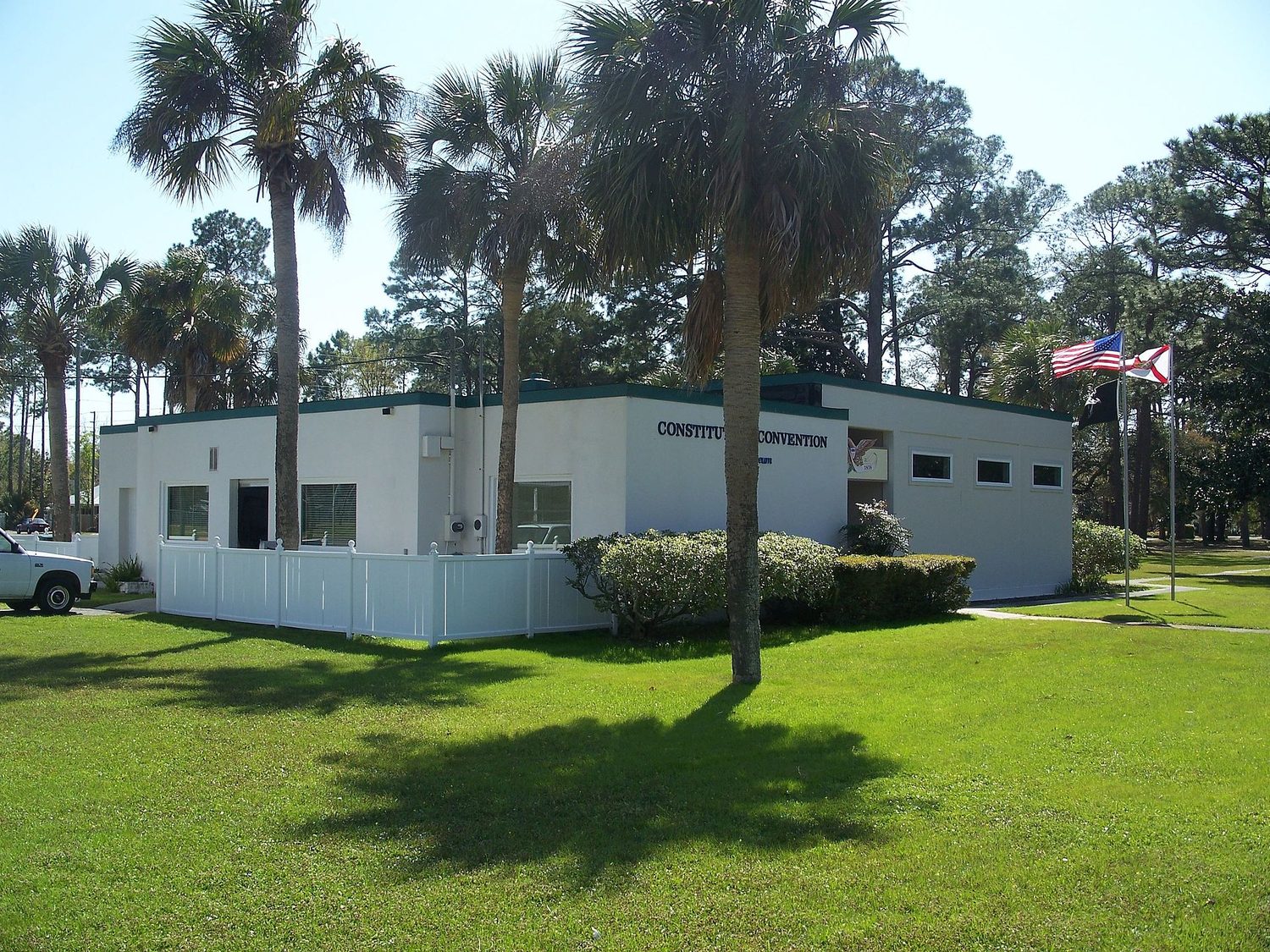
If you want a date, come in December. Florida’s statehood began here. Territorial delegates met at St. Joseph from 3 December 1838 to 11 January 1839 to write the state’s first constitution. The town’s motto is still Birthplace of the Florida Constitution.
The convention hall is gone. The town is gone. But the document survives, and so does the memory of the meeting. The delegates gathered in a raw settlement on the edge of the Gulf, wrote a frame of government, and then watched their city die of fever and flood. There is no better time to stand on that ground than in December, when the air is cool and the light is low and you can almost hear the scratch of pens.
A reproduction of the convention hall stands on 14 acres outside town, with audio-animated recreations of the 1838 delegates. It is not a monument to triumph. It is a monument to what was written before the storm.
The Edge of the Cape
West of town, in Gulf County, lies Cape San Blas and its lighthouse. The cape is a thin spit of sand that has been battered and rebuilt by every major storm. The lighthouse has been moved, rebuilt, and moved again. It is the perfect symbol for this place: a warning light that refuses to stay put, because the sand itself will not stay put.
Walk the cape in the winter. The crowds are gone. The wind is sharp. The water is a deep, cold green. You will understand why the first town chose this coast, and why the sea took it back.
What You Should Not Do
Do not come here looking for paradise. That word is a lie, and the town knows it. Do not come for the generic postcard version of Florida, the one with the palm trees and the pastel sunsets. Come for the specific, grave beauty of a place that has already died once and decided to stay anyway.
Thirty-three percent of residents hold a bachelor’s degree or higher. That is a thoughtful population. They know what happened here. They chose to live on ground that was once a graveyard of ambition.
The Verdict
The best time of year to visit Port St. Joe is the week after the last hurricane threat has passed and the week before the first spring break crowd arrives. That window is not on any calendar. It is a feeling. The town will be quiet. The water will be cold. The history will be close.
Come in December, when the constitution is on your mind. Come in February, when the town is nearly empty. Come in the gray light of a winter afternoon, when the bay looks like pewter and the lighthouse stands alone against the sky.
Come when you are ready to stand on ground that has been erased and rebuilt, and to think about what survives.
That is the season.
Every business named above is one we hold a listing for, and every date traces to a source on our sources page. We do not describe menus, interiors or service we have not verified. Details change — confirm before you travel.